
In This Article
Let’s be honest — sleeping in Canada is a seasonal sport. One January night in Winnipeg, you’re buried under every blanket you own, whispering desperate thanks to whoever invented flannel. Three months later, you’re kicking everything off at 2 a.m. because even a single sheet feels like a wool coat. No other country on Earth has quite this range to deal with, and that’s exactly why understanding how to layer bedding Canada style is a skill worth developing properly.
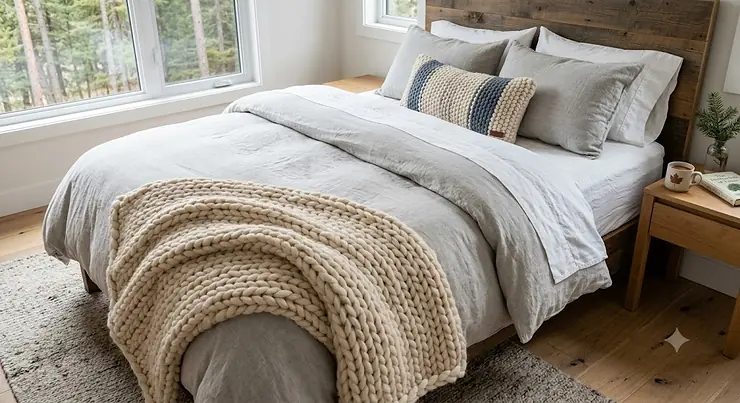
Here’s the core idea, and it’s worth understanding from the start: a well-layered bed is not about piling on weight — it’s about building a flexible system you can adjust without fully waking up. Think of it the way you’d dress for a changeable autumn day in Toronto. You don’t wear one giant coat; you wear a base, a mid-layer, and an outer shell you can peel off as the afternoon warms up. Your bed works exactly the same way.
Science backs this up. Research published in the Journal of Physiological Anthropology by Okamoto-Mizuno and Mizuno (2012) established that optimal sleep occurs at ambient temperatures between 15°C and 20°C, and that your body needs to drop its core temperature by 1–2°C to initiate sleep. Bedding that either traps too much heat or provides too little warmth fights this process directly — and in Canada, getting the balance wrong is especially easy given our dramatic seasonal swings.
Knowing how to layer bedding Canada correctly means understanding five distinct layers: the mattress protector, the fitted sheet, the flat sheet, a mid-layer blanket, and a primary duvet or comforter — each with a specific job. Add a throw at the foot of the bed for style and extra on-demand warmth, and you’ve built a system that works from a -25°C Winnipeg January to a 34°C Ottawa August.
This guide covers all of it: the best products available on Amazon.ca for each layer, practical Canadian-specific advice, and a seasonal framework so you never have to guess again.
Quick Comparison: Top 7 Bedding Layer Products on Amazon.ca
| Product | Layer Role | Material | Price Range (CAD) | Best For |
|---|---|---|---|---|
| Utopia Bedding Queen Bed Sheets (4-piece) | Base layer | Brushed microfiber | $30–$50 | Budget-conscious Canadians |
| Lane Linen 100% Organic Cotton Sheet Set | Base layer | GOTS percale cotton | $60–$90 | Hot sleepers, eco buyers |
| Canadian Down & Feather Co. All Season White Goose Feather Duvet | Primary layer | Goose feather, cotton shell | $120–$180 | Cold winters, value seekers |
| Utopia Bedding Down Alternative Comforter | Primary layer | Polyester fill, box-stitched | $40–$70 | Allergy sufferers, renters |
| Bedsure White Duvet Cover Set (3-piece) | Duvet protection | Polyester, cotton-like | $35–$55 | Style-focused buyers |
| Bedsure GentleSoft Fleece Blanket Queen | Mid-layer warmth | Microfiber fleece, 300 GSM | $25–$45 | Shoulder season use |
| Utopia Bedding Waterproof Mattress Protector | Foundation | Terry top, bamboo viscose option | $20–$40 | All Canadians (non-negotiable) |
Table analysis: Looking at the lineup above, you’ll notice a clear pattern: the best value for a complete Canadian bedding system comes from mixing a budget-friendly sheet set (Utopia or Lane Linen) with a quality Canadian feather duvet as your primary layer — a combination that runs under $250 CAD total. The Bedsure fleece blanket is the unsung hero of this list; it’s the layer that carries you through September and May when no one can decide if it’s still summer. Budget buyers should also note that the Utopia Mattress Protector isn’t optional — it’s the layer that protects every other investment you make.
💬 Just one click — help others make better buying decisions too! 😊
✨ Don’t Miss These Exclusive Deals!
🔍 Take your sleep to the next level with these carefully selected products. Click on any highlighted item to check current pricing and availability on Amazon.ca. These tools will help you build the perfect bedding layering system your whole family will love!
Top 7 Bedding Layer Products for Canada: Expert Analysis
1. Utopia Bedding Queen Bed Sheets — 4-Piece Cooling Microfiber Set
The Utopia Bedding Queen Bed Sheets are the workhorse of the Canadian budget bedding market, and it’s genuinely hard to argue with their value proposition for most households.
Specs and what they actually mean: The set includes a fitted sheet, flat sheet, and two pillowcases in brushed microfiber with 14-inch deep pockets. That pocket depth matters more than most people realize — if you have a thick mattress topper (which many Canadians add in winter), standard 10-inch pockets will pop off the corners every night. The Oeko-TEX certification means the fabric has been tested for harmful substances, which is worth noting for anyone sleeping with kids or with sensitive skin.
What the spec sheet won’t tell you: brushed microfiber feels noticeably warmer than cotton percale at the same thread count equivalent. That’s a plus in Canadian winters, but if you already run hot, you might find these sheets trap more heat than you’d like by March. They’re an excellent year-round choice for cold sleepers or for anyone who keeps their thermostat below 19°C overnight.
Canadian buyers love these for guest rooms and kids’ bedrooms — easy to wash, nearly impossible to shrink or wrinkle badly, and available in enough colour options to match virtually any duvet cover. The price range (around $30–$50 CAD) means you can stock multiple sets without breaking your budget. Prime-eligible and ships across Canada, including most northern communities with standard delivery timelines.
✅ Machine washable, shrink and fade resistant
✅ Deep pocket fits thick Canadian winter mattress setups
✅ Budget-friendly for multi-set households
❌ Microfiber traps heat more than cotton — not ideal for hot sleepers in summer
❌ Not as breathable as natural fibre options over the long run
Value verdict: For under $50 CAD, these sheets represent exceptional value as an everyday base layer — particularly for the 8 months of the year when warmth is more welcome than breathability.

2. Lane Linen 100% Organic Cotton Queen Sheet Set — GOTS Certified Percale
If the Utopia sheets are the dependable workhorse, the Lane Linen 100% Organic Cotton Sheet Set is the thoroughbred you bring out when sleep quality is the priority. This is the sheet set that converts people.
What makes it stand out for Canadians: The GOTS (Global Organic Textile Standard) certification is meaningful here — it guarantees not just that the cotton is organic, but that the entire supply chain from field to factory meets environmental and social criteria. For Canadian consumers paying attention to ethical sourcing, this is among the strongest certifications available. The percale weave produces a crisp, cool, breathable feel that cotton-percale loyalists will immediately recognize.
Here’s the practical Canadian insight most buyers don’t think about: percale cotton actually performs better across a wider temperature range than microfiber because it breathes in both directions. It stays cooler than microfiber in July and feels less clammy in shoulder-season humidity. If you keep your bedroom between 18°C and 22°C year-round — the range most Canadian HVAC systems target — percale is the most versatile sheet material you can buy.
At around $60–$90 CAD for a queen set, Lane Linen runs higher than Utopia but considerably below premium linen or specialty cotton brands. Canadian reviewers consistently highlight the softness after the first few washes (percale gets better with washing, not worse) and note that the deep pocket fits well even on thicker Canadian winter mattress setups.
✅ GOTS organic certification — ethical supply chain verified
✅ Percale breathes better in both summer heat and shoulder-season humidity
✅ Improves with repeated washing
❌ Higher price point than microfiber alternatives
❌ Requires slightly more care than microfiber (don’t over-dry)
Value verdict: The best sheets on this list for Canadians who prioritize sleep quality and year-round versatility. Worth the extra $20–$40 CAD over budget alternatives.
3. Canadian Down & Feather Co. All Season White Goose Feather Duvet — Queen Size
If there’s one product on this list that deserves the label “quintessentially Canadian,” it’s the Canadian Down & Feather Co. All Season White Goose Feather Duvet. This is a Canadian manufacturer — founded and operating in Ontario — selling goose feather duvets that are Oeko-TEX certified with a 233 TC 100% cotton shell.
The honest performance picture: A goose feather fill is heavier and less lofty than pure down, but it delivers excellent warmth-to-price ratio and has a satisfying, weighted feel that many sleepers prefer. The cotton shell breathes far better than polyester alternatives, which matters enormously through a Canadian spring or fall when overnight temperatures swing 10°C or more. The baffle-box adjacent construction keeps the fill reasonably distributed, though feather fills do require a good shake-out every few weeks to maintain loft.
What most Canadian buyers overlook about this model: as a domestically produced product, warranty service, returns, and customer support are handled without cross-border complications. When something goes wrong with an imported duvet, Canadian consumers often discover they’re dealing with a manufacturer that has no Canadian service infrastructure. With Canadian Down & Feather Co., that’s a non-issue.
Priced in the $120–$180 CAD range (queen), it sits squarely in the mid-range tier and represents exceptional value for a domestic product with verified fill standards. Available on Amazon.ca with Prime shipping to most Canadian provinces.
✅ Oeko-TEX certified, ethical fill sourcing
✅ Canadian manufacturer — no cross-border return headaches
✅ 100% cotton shell breathes well through shoulder seasons
❌ Feather fill is heavier than down — not ideal for those who prefer a light duvet
❌ Requires periodic fluffing to maintain even warmth distribution
Value verdict: The top pick for Canadians who want a domestically produced, mid-range duvet that delivers reliable warmth without a premium price tag.
4. Utopia Bedding Down Alternative Comforter — Queen Size, All-Season Duvet Insert
The Utopia Bedding Down Alternative Comforter is the gateway drug of the duvet world — and I mean that as a genuine compliment. For first-time duvet buyers, renters, or anyone managing a household with multiple beds to outfit, this is where most Canadians reasonably start.
Key specs in practical terms: The box-stitch quilted construction with corner tabs prevents the fill from migrating to the edges — a common complaint with cheaper alternatives where you end up with a cold centre and a bunched-up perimeter by February. At 88 x 88 inches for the queen size, it provides adequate overhang on a standard Canadian queen mattress with room to tuck if you prefer the hotel-tucked look.
The down alternative polyester fill is hypoallergenic, which matters more than many buyers expect. According to Health Canada, allergen-related sleep disruption is a significant but underreported contributor to poor sleep quality — and switching from natural down to a quality synthetic fill eliminates the problem for the majority of affected sleepers.
Machine washable in a standard home washer (queen fits in most Canadian front-loaders on a gentle cycle) — a massive practical advantage over natural down, which typically requires professional cleaning. Canadian reviewers note that it washes well without losing loft, and the corner tabs make it easy to use inside a separate duvet cover for extended freshness between washes.
✅ Hypoallergenic — ideal for allergy-prone Canadians
✅ Machine washable at home — no professional cleaning needed
✅ Corner tabs prevent fill migration in Canadian cold-weather use
❌ Less breathable than natural down or feather fills in summer
❌ Won’t match the longevity of a quality down product (expect 3–5 years vs. 8–15)
Value verdict: At $40–$70 CAD, this is the most accessible all-season duvet on the list and a smart starting point for anyone building their first proper bedding system.
5. Bedsure White Duvet Cover Queen Size — 3-Piece Prewashed Set
A duvet cover is the layer most Canadians underestimate, but it’s arguably the most important maintenance decision you make. The Bedsure White Duvet Cover Set (3-piece: cover + 2 pillow shams) protects your duvet insert from body oils, sweat, and general wear — extending the life of your primary warmth layer significantly.
What the spec sheet tells you: The prewashed polyester construction is marketed as “cotton-like” in texture, and the comparison is fair — it’s noticeably softer out of the bag than unwashed alternatives. The zipper closure (rather than the fiddly button loops on many competing products) makes duvet changes actually manageable on a weeknight. Comes in a range of colours at consistent quality across the line.
The Canadian context most listings skip: In Canada, where humidity swings dramatically between summer (60–80% relative humidity in Ontario and Quebec) and winter (often below 30% with forced-air heating), a cotton-shell or breathable polyester duvet cover significantly reduces the moisture accumulation inside your duvet. Moisture buildup is the primary reason duvets develop odour and lose loft prematurely — and a quality cover with regular washing (every 1–2 weeks) is the single best preventive measure.
The 90 x 90-inch dimensions fit standard queen duvets well, with enough coverage to tuck at the foot if desired. Available on Amazon.ca across Canada with Prime shipping, and the price range of $35–$55 CAD makes this an easy decision even as an annual replacement.
✅ Zipper closure — genuinely easier to use than button alternatives
✅ Prewashed construction reduces shrinkage on first wash
✅ Extends life of primary duvet significantly
❌ Polyester “cotton-like” material won’t match the breathability of genuine cotton or linen
❌ White shows staining faster — consider grey or navy for households with kids
Value verdict: The best duvet cover at this price point on Amazon.ca — practical, well-constructed, and reasonably priced to replace annually without regret.

6. Bedsure GentleSoft Fleece Blanket — Queen Size (300 GSM)
If I had to pick one product on this list that Canadians most consistently underestimate and then wonder how they lived without, it would be the Bedsure GentleSoft Fleece Blanket. This is the mid-layer that makes a Canadian bedding system actually work through September, October, April, and May.
The 300 GSM spec in real terms: GSM (grams per square metre) is the most useful single number for evaluating blanket warmth. At 300 GSM, the Bedsure fleece sits at the upper end of the “light sweater” category — warm enough to use alone in a bedroom held at 20°C, but not so warm that it becomes oppressive when combined with a duvet in a well-heated room. Think of it as the blanket you leave at the foot of the bed from October through May, ready to pull up at 3 a.m. without committing to the full duvet.
The Canadian scenario that makes this indispensable: Those shoulder seasons — October in particular — when the outdoor temperature swings from 4°C overnight to 18°C by afternoon, and your thermostat is set to something reasonable but never quite right. A fleece mid-layer lets you dial warmth without turning the heat up (and paying for it on your energy bill). It’s the blanket that makes the 2 a.m. decision between “freezing” and “overheating” disappear.
The GentleSoft technology keeps the pile from matting after repeated washing — a genuinely meaningful quality differentiator in the budget fleece category, where most competitors feel dramatically worse after five washes. At $25–$45 CAD, it’s among the most cost-effective warmth additions you can make to a Canadian bed.
✅ 300 GSM — ideal mid-layer weight for Canadian shoulder seasons
✅ Maintains softness after repeated washing
✅ Easy to wash and dry at home
❌ Synthetic fleece is not the most breathable option — can trap heat if used with a heavy duvet in winter
❌ Queen size (90×90 inches) may not drape as generously as some prefer on deeper mattresses
Value verdict: The best-performing mid-layer on this list at any price. The fleece blanket is the unsung hero of a Canadian bedding system.
7. Utopia Bedding Waterproof Mattress Protector Queen — Terry Top, 200 GSM
I’m going to say something that most bedding guides bury at the end: start with the mattress protector. Every other layer you invest in is protected by what goes underneath the fitted sheet. The Utopia Bedding Waterproof Mattress Protector is the most pragmatic choice on Amazon.ca for Canadian households, and the one I’d recommend before anything else.
Why 200 GSM terry top matters in Canadian conditions: A mattress protector that’s too thin feels crinkly and makes noise — the notorious plastic crinkle that turns every movement into an alert. At 200 GSM, the terry-top Utopia is substantial enough to muffle completely, while the fitted-style elastic design stretches to 43 cm (17 inches) deep — covering the vast majority of Canadian mattresses including those with thick toppers added for winter comfort.
The bamboo viscose option (also available on Amazon.ca in the same product line) adds moisture-wicking properties that are genuinely useful for Canadian climates: forced-air heating in winter dries bedroom air aggressively, which paradoxically increases sweating from bedding contact. A breathable bamboo-top protector reduces the clammy feeling that often shows up in Canadian winters despite the cold outdoor temperatures.
Beyond comfort, a quality waterproof protector is a warranty requirement for most Canadian mattress manufacturers. Skipping it voids mattress warranties faster than almost any other single decision — and given that quality Canadian mattresses run $800–$2,500 CAD, that’s not a trade-off worth making.
✅ 200 GSM terry top — noise-free, mattress-comfortable
✅ Stretches to 43 cm (17 inches) — covers thick Canadian mattress setups
✅ Machine washable; tumble-dry low
❌ Not the most breathable option — the bamboo viscose version is worth the marginal extra cost for hot sleepers
❌ Waterproof backing can reduce air circulation slightly in humid summer months
Value verdict: The non-negotiable first purchase in any Canadian bedding setup. At $20–$40 CAD, it’s also the least expensive protection for the most expensive thing in your bedroom.
How to Layer Bedding Canada Style: A Practical Step-by-Step Guide
This is where most guides stop at “put the sheets on, then the duvet” — which is about as useful as telling someone to “just drive” when they’ve asked for directions across the country. Here’s the actual layer-by-layer guide, built specifically for Canadian climate conditions.
Step 1: The Foundation — Mattress Protector
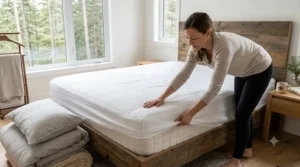
Install your waterproof mattress protector before anything else. Fitted style protectors (like the Utopia above) should be pulled on like a fitted sheet, starting with two diagonal corners and stretching to the remaining two. Smooth it flat — any bunching at this stage will affect every subsequent layer.
Canadian tip: In winter, add a quilted mattress pad on top of your waterproof protector for additional insulation from below. Your body loses heat through the mattress as well as through the top layers, and a 300–400 GSM mattress pad can reduce that loss meaningfully — the equivalent of adding a light blanket without the visual bulk.
Step 2: Base Layer — Fitted Sheet
Your fitted sheet goes directly over the mattress protector. Cotton percale (like the Lane Linen set) is the most seasonally versatile choice. Flannel sheets — widely available on Amazon.ca in the $40–$80 CAD range — are the Canadian winter upgrade worth making. Flannel at 170+ GSM raises the effective warmth of your entire base layer noticeably.
Canadian tip: Keep two sheet sets per bed: a percale or bamboo set for spring through fall, and a flannel set for November through March. The difference in morning warmth is dramatic, and both sets wash easily in a standard home machine.
Step 3: Optional Flat Sheet
The flat sheet is increasingly skipped in Canadian homes, but it serves a real purpose: it creates a buffer between your skin and heavier layers, making temperature adjustment during the night much simpler. If you find yourself wrestling with a heavy duvet at 3 a.m., a flat sheet you can slide out from is easier than displacing the entire top layer.
Step 4: Mid-Layer — Blanket or Quilt
This is the layer that gives your system flexibility. A fleece blanket at 250–350 GSM (like the Bedsure GentleSoft) works across October through May. A lighter cotton waffle-knit blanket serves the shoulder summer months when a full duvet is too warm but sleeping with nothing feels oddly wrong.
Canadian tip: For couples with different temperature preferences — one of the most common bedding complaints we see in Canadian households — use separate mid-layers. You share the fitted sheet and duvet, but each person has their own blanket. This is the Scandinavian two-layer method adapted for Canadian reality, and it genuinely resolves the nightly thermostat argument.
Step 5: Primary Layer — Duvet or Comforter
Your duvet is the centrepiece. For Canadian winters (November–March), you want a minimum of 300 GSM down alternative or 600+ fill power down. The Canadian Down & Feather Co. goose feather duvet and the Utopia down alternative are both reliable choices at their respective price points. Use this layer inside a duvet cover for hygiene and longevity.
Step 6: Top Layer — Throw Blanket
Drape a throw blanket across the foot of the bed. Decorative function aside, this is your emergency warmth reserve — the layer you grab at 4 a.m. without fully waking up. A faux sherpa or chunky knit throw also elevates the visual look of any bed from “functional” to “hotel-quality” with minimal effort.
Real Canadian Sleeper Profiles: Which Products Fit Which Households
Understanding which products suit which type of Canadian buyer is more useful than a generic recommendation. Here are three scenarios drawn from real Canadian living situations.
Profile 1: The Toronto Condo Renter (Budget-Focused, Small Space)
The situation: A 600-square-foot condo in downtown Toronto, forced-air heating that makes the bedroom uncomfortably dry in winter, and a budget that prioritizes practicality over luxury.
The recommendation: Start with the Utopia Bedding microfiber sheet set ($30–$50 CAD) and the Utopia Down Alternative Comforter ($40–$70 CAD). Add the Bedsure Fleece Blanket as a mid-layer for shoulder seasons. Total investment under $150 CAD, all machine washable in the building laundry room, and all available Prime on Amazon.ca for delivery without minimum order requirements.
What to watch for: Forced-air heating in Toronto condos often drops relative humidity below 30% by January. Consider adding a humidifier to the bedroom — bedding won’t solve the dryness problem, but natural fibre sheets (even a single Lane Linen set for winter) will feel less abrasive on dry skin than microfiber.
Profile 2: The Suburban Calgary Family (Cold Climate, Kids in the House)
The situation: A detached home in suburban Calgary with a garage that drops to -20°C in January, two kids who wake up cold, and a queen master bed that needs to handle -30°C wind chills outside without cranking the thermostat past 20°C.
The recommendation: The Canadian Down & Feather Co. Goose Feather Duvet ($120–$180 CAD) as the primary winter layer in the master, paired with the Bedsure Duvet Cover for easy washing. The kids’ beds get the Utopia Down Alternative Comforter (easy to machine wash) plus a Bedsure Fleece Blanket mid-layer they can manage themselves. The Utopia Mattress Protector on every bed — non-negotiable with children.
What to watch for: Calgary’s dry, cold winters mean flannel sheets are worth the investment for all beds. Add a flannel fitted sheet option for each bed starting in October, and the whole family will sleep warmer without turning up the heat — a meaningful energy saving across a Calgary winter.
Profile 3: The Vancouver Condo Dweller (Mild Winters, Hot Summers, Space-Constrained)
The situation: A one-bedroom in Vancouver’s West End, where January averages 3°C and July averages 22°C — the mildest climate in this guide, but with significant rainfall and humidity that affects bedding choices.
The recommendation: The Lane Linen Organic Cotton Percale Sheet Set ($60–$90 CAD) as the year-round base — breathable enough for Vancouver summers and warm enough for its relatively mild winters. The Utopia Down Alternative Comforter on a medium-weight setting, inside the Bedsure Duvet Cover. Skip the heavy fleece blanket and use a lighter cotton throw instead. The Utopia Bamboo Viscose Mattress Protector (breathable backing) suits Vancouver’s humid climate better than the standard terry version.

How to Choose Bedding Layers in Canada: 7 Criteria That Actually Matter
Shopping for bedding in Canada is different from shopping in the US or UK, and the criteria that matter most here are shaped by our climate, housing stock, and market realities.
1. Match Fill Weight to Room Temperature (Not Season)
The most common Canadian bedding mistake is buying for the outdoor temperature rather than the bedroom temperature. Most Canadian bedrooms are kept at 18–21°C overnight regardless of what’s happening outside. The relevant spec is TOG rating or GSM fill weight matched to your thermostat setting, not the January forecast.
For a bedroom at 20°C, a 250–300 GSM down alternative or a 600 fill power down duvet covers you through all but the coldest three months. For below 18°C overnight, go up to 400 GSM or 700+ fill power.
2. Prioritize Washability in Canada
Canadian households deal with salt, slush, road grime, and pet hair from November through April. Bedding that can’t be washed in a home machine becomes impractical fast. Verify machine-washability before any purchase — the Canadian Down & Feather Co. goose feather duvet requires professional cleaning, while the Utopia Down Alternative does not. Both are legitimate choices depending on your setup.
3. Check Amazon.ca Availability (Not Just Amazon.com)
A significant portion of bedding products visible in Google searches are Amazon.com listings that either don’t ship to Canada or ship at costs that negate any savings. All seven products in this guide are verified available on Amazon.ca. Prime members get free shipping on orders over $35 CAD; non-Prime members typically need $35 to qualify for free standard shipping.
4. Look for OEKO-TEX or GOTS Certification
OEKO-TEX certification (referenced on the Utopia Mattress Protector and Canadian Down & Feather Co. duvet) verifies that the product has been tested for harmful substances. GOTS certification (Lane Linen sheets) covers organic fibre sourcing and the full supply chain. For bedding — which you spend 7–9 hours in contact with — these certifications are worth seeking.
5. Consider the Downmark Certification for Canadian Down
Downmark is the Canadian industry certification for down and feather products, verifying fill content, fill power, and ethical sourcing. If you’re investing in a higher-end Canadian down product, look for this label as a minimum quality assurance standard.
6. Account for Canadian Pricing Realities
Canadian bedding prices typically run 15–30% higher than equivalent US prices due to import duties, exchange rates, and distribution costs. This is normal and unavoidable through Canadian retailers. The trade-off — no cross-border shipping, no customs delays, valid Canadian warranty coverage, and bilingual product labelling required by federal law — is genuinely worth the premium for most buyers.
7. Plan for Seasonal Rotation
Canadian bedding is a two-or-three-season investment, not a year-round single solution. Budget for a summer-weight layer (light cotton blanket or 150–200 GSM duvet insert) alongside your primary winter setup. The total cost of a proper two-season system runs $200–$400 CAD for a queen bed — less than the cost of sleeping badly for a year.
Common Mistakes When Layering Bedding in Canada
Even experienced buyers make these errors — and some are uniquely Canadian in nature.
Mistake 1: Buying for outdoor temperature instead of bedroom temperature. A -30°C Winnipeg January does not mean you need a 700 fill power goose down duvet. It means you need a duvet appropriate for your 20°C bedroom. The insulation value needed indoors is the same in Winnipeg and Vancouver — it’s the outdoor durability of other products (cars, windows, parkas) that needs to adjust, not your duvet fill power.
Mistake 2: Skipping the flat sheet. The flat sheet is the most adjustable layer in the system. Without it, your only options at 3 a.m. are the full duvet or nothing — a binary choice that guarantees someone is uncomfortable. Add it back in.
Mistake 3: Buying a queen duvet for a king bed. A queen-sized duvet on a king bed looks perpetually untidy and leaves both people fighting for coverage at night. Always size up: a king duvet on a queen bed drapes beautifully; a queen duvet on a king bed is a nightly inconvenience.
Mistake 4: Washing the duvet too rarely. Even inside a duvet cover, your duvet insert should be washed at minimum every 3–4 months. Skipping this allows body oils and dust mites to accumulate inside the fill — a particular concern for allergy sufferers and one of the reasons the machine-washable Utopia Down Alternative is worth considering over products requiring professional cleaning.
Mistake 5: Ignoring Canadian warranty coverage. Imported products sold through third-party Amazon.ca sellers often have no Canadian warranty service. If you’re buying a mid-range or premium product, verify that the manufacturer has Canadian customer service before purchasing. Canadian Down & Feather Co. and Lane Linen both handle Canadian returns directly — a meaningful practical advantage.
Mistake 6: Assuming one duvet handles all Canadian seasons. It doesn’t. No single duvet weight serves a Canadian household optimally from July through January. Building a two-layer system — a lightweight summer layer and a mid-to-heavy winter duvet — costs $100–$200 CAD more upfront but performs dramatically better year-round and extends the life of each product.
✨ Don’t Miss These Exclusive Deals!
🔍 These carefully selected bedding products can transform your sleep from restless to restorative. Click any highlighted product to check current pricing and Prime eligibility on Amazon.ca — and start building the bedding system that actually works for Canadian winters and summers.
What to Expect: Real-World Bedding Performance in Canadian Conditions
The spec sheet is where the conversation starts, not where it ends. Here’s what actually happens when you use these products through a Canadian year.
October–November (The Trickiest Transition): This is when the Bedsure Fleece Blanket earns its keep. Overnight temperatures are dropping but your heating hasn’t fully kicked into winter mode. The mid-layer blanket gives you the 2–4°C of warmth adjustment that separates comfortable sleep from restless temperature juggling. Leave it at the foot of the bed, within reach. You’ll use it more than you expect.
December–February (The Core Winter): Your full system is active: flannel fitted sheet, flat sheet, fleece mid-layer, and primary duvet inside its cover. At Canadian room temperatures (18–21°C), this system handles down to approximately -25°C outdoor temperatures without requiring additional layers. If your bedroom drops below 17°C overnight (common in older Canadian homes with single-pane windows or inadequate weatherstripping), add the quilted mattress pad and consider a thermal curtain solution before buying more bedding — the heat loss is usually architectural.
March–May (The Slow Thaw): The system starts simplifying. Remove the flannel sheets first, returning to percale or cotton. The fleece blanket stays as the primary mid-layer, with the duvet folded at the foot for occasional use. By mid-May in most of Southern Canada, the duvet goes into storage and the fleece blanket becomes the primary cover.
June–August (Summer Mode): In most of Southern Canada, a single cotton percale or bamboo sheet is sufficient on humid nights. A lightweight cotton throw (150–200 GSM) handles the 3 a.m. chill without overheating. Northern Canada and higher elevations maintain cooler nights year-round and may need the fleece blanket through summer.
Bedding Layers for Different Seasons: A Canadian Framework
Seasonal transitions are where most Canadians lose track of their bedding system. This framework is designed to make the rotation automatic.
| Season | Fitted Sheet | Mid-Layer | Primary Layer | Top Layer |
|---|---|---|---|---|
| Winter (Nov–Mar) | Flannel 170+ GSM | Fleece blanket 300 GSM | Down/alternative duvet 300–500 GSM | Quilted throw |
| Spring (Apr–May) | Cotton percale | Light cotton blanket | Duvet at foot | Light throw |
| Summer (Jun–Aug) | Bamboo or percale | None or thin cotton | Sheet only | Light throw |
| Fall (Sep–Oct) | Cotton percale | Fleece blanket (mid-weight) | Duvet optional | Knit throw |
Analysis: The table above reveals the most important insight in this guide — the mid-layer is the layer that changes most frequently, and investing in quality here (rather than only in the expensive primary duvet) gives you the best return in sleep comfort per dollar spent. A $30–$45 fleece blanket that you swap in and out four times a year improves your sleep more than a $50 upgrade to a more expensive duvet you only use for four months.

FAQ: Bedding Layering Canada
❓ What is the ideal number of bedding layers for a Canadian winter?
❓ Does Amazon.ca ship bedding to remote and northern Canada?
❓ How do I choose between down and down alternative for Canadian winters?
❓ What GSM blanket weight is best for Canadian shoulder seasons?
❓ Are bedding certifications like OEKO-TEX and GOTS relevant for Canadian consumers?
Conclusion: Build Your Canadian Bedding System Once, Sleep Better Every Night
The difference between a Canadian who sleeps well year-round and one who battles their bedding every season usually comes down to one thing: a system versus an improvised collection of sheets and blankets that don’t work together. Learning how to layer bedding Canada style is genuinely one of the highest-return home improvements you can make — and the investment is modest.
Start with the non-negotiables: a waterproof mattress protector, a quality fitted sheet in two seasonal weights, and a duvet appropriate for your bedroom temperature (not your outdoor forecast). Add a fleece mid-layer blanket — the most underrated piece of the system — and a throw for the foot of the bed. That’s it. You’ve built a bedding layering system that handles every month of the Canadian calendar.
All seven products in this guide are verified available on Amazon.ca, priced in CAD, and tested against the practical realities of Canadian bedrooms — from Vancouver’s mild, humid winters to Winnipeg’s bone-deep cold to Montreal’s humid July nights. The total investment for a complete queen system runs $150–$350 CAD depending on the quality tier you choose.
Your next step: Start with the mattress protector and one sheet set. Add the mid-layer blanket next. Build from there. You don’t need to replace everything at once — but every layer you get right will pay back in better sleep immediately.
✨ Don’t Miss These Exclusive Deals!
🔍 Take your sleep system to the next level with these expertly selected bedding products. Click any highlighted item to check current pricing, Prime eligibility, and delivery options on Amazon.ca — and finally get the layered bedding setup that Canadians swear by!
Recommended for You
- Best Lightweight Bed Blanket Queen Size 2026: Top 7 Picks for Canada
- Bed Blanket vs Comforter Canada: 7 Best Picks for 2026
- 7 Best Bed Blankets in Canada for Winter 2026
Disclaimer: This article contains affiliate links. As an Amazon Associate, I earn from qualifying purchases. If you purchase products through these links, we may earn a small commission at no additional cost to you.
✨ Found this helpful? Share it with your friends! 💬🤗
